The Weather Project: How Olafur Eliasson Built a Sun Inside Tate Modern
A semicircle of mono-frequency lamps, a mirrored ceiling and a fine artificial mist turned the Turbine Hall into one of the most visited art installations of the century.
Project summary
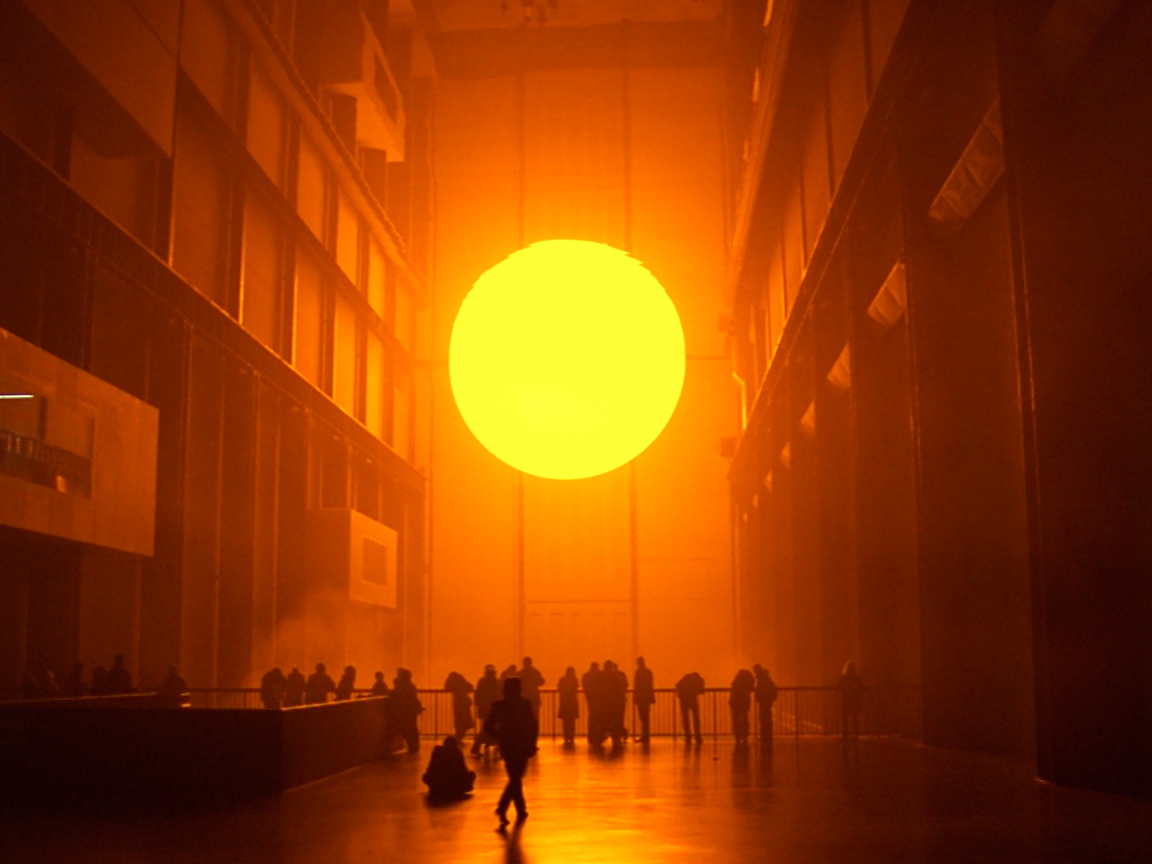
For the fourth commission in Tate Modern's Unilever Series, Danish-Icelandic artist Olafur Eliasson filled the 155-metre-long Turbine Hall with a single, overwhelming light source: a glowing half-disc mounted high on the far wall. A mirrored ceiling spanning the hall reflected the semicircle into a complete sun, while a thin mist hung in the air like London fog at dusk.
The work became a phenomenon. Visitors lay on the concrete floor for hours, waving at their own reflections in the ceiling far above. Roughly two million people saw the installation during its five-month run, and it remains a reference point for how light alone can shape the experience of an architectural volume.
For lighting professionals, The Weather Project is a case study in restraint: a single wavelength, an enormous reflective plane and atmospheric haze did the work that a conventional scheme would attempt with hundreds of fixtures.
Key team
Olafur Eliasson
Born in Copenhagen in 1967 to Icelandic parents, Eliasson studied at the Royal Danish Academy of Fine Arts and founded Studio Olafur Eliasson in Berlin in 1995. His practice spans installation, architecture and public projects that explore perception, light and natural phenomena — from Your rainbow panorama in Aarhus to the façade of Harpa concert hall in Reykjavík. He also co-founded Little Sun, a social business distributing solar lamps to communities without grid electricity.
Studio Olafur Eliasson
A Berlin-based studio of craftspeople, architects, engineers, technicians and researchers that develops, tests and builds Eliasson's works in-house, including the full-scale optical experiments that preceded the Turbine Hall installation.
Tate Modern curatorial team
The Unilever Series, launched in 2000, invited one artist each year to create a work for the Turbine Hall. The commission gave Eliasson the full volume of the former power station's generator hall to work with.
The process
- 01
Choosing a single wavelength
The 'sun' was a semicircular screen backlit by around two hundred mono-frequency lamps — the same low-pressure sodium technology once used in street lighting. Because these lamps emit almost exclusively at one yellow-orange wavelength, every other colour in the hall collapsed into shades of yellow and black, giving the space its surreal, duotone quality.
- 02
Doubling the space with a mirror
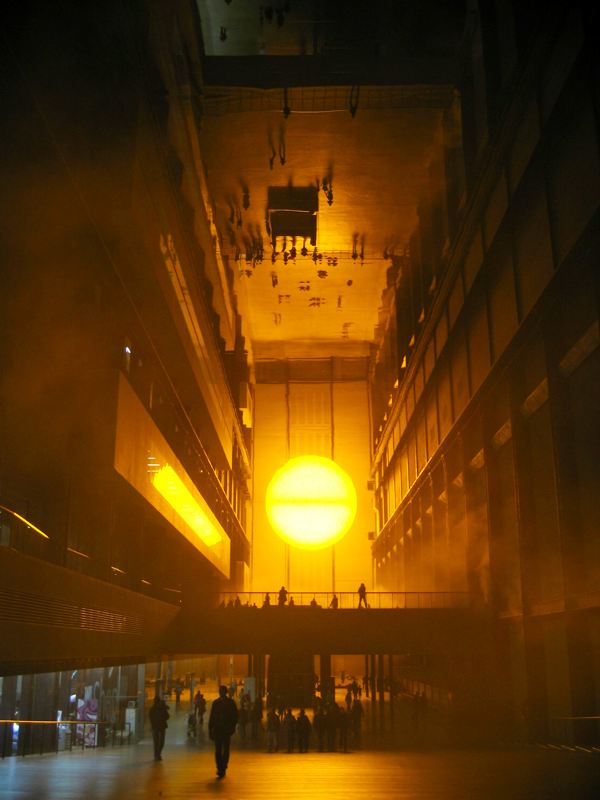
The ceiling of the Turbine Hall was covered by a framework of mirrored foil panels. The reflection completed the half-disc into a full circle and doubled the apparent height of the hall. Visitors' reflections — tiny figures on the ceiling — became part of the work.
- 03
Making the light visible
Humidifiers dispersed a fine mist of sugar and water into the hall at intervals. The haze caught the light, making the beam volume visible and dissolving the edges of the space. Mist levels built up and cleared over the day, so the atmosphere was never quite the same twice.
- 04
Exposing the mechanism
Climbing the stairs to the mezzanine revealed the scaffolding, lamp arrays and mirror framework. Eliasson intended this: the work invited visitors to see how the illusion was made and still choose to experience it.
Gallery


Lessons for specifiers
- → A single, narrow-spectrum source can define an entire volume.
- → Reflective planes multiply perceived scale without adding fixtures.
- → Atmosphere (haze) is a lighting material, not an afterthought.
- → Letting users see the 'machinery' can deepen rather than break the experience.

